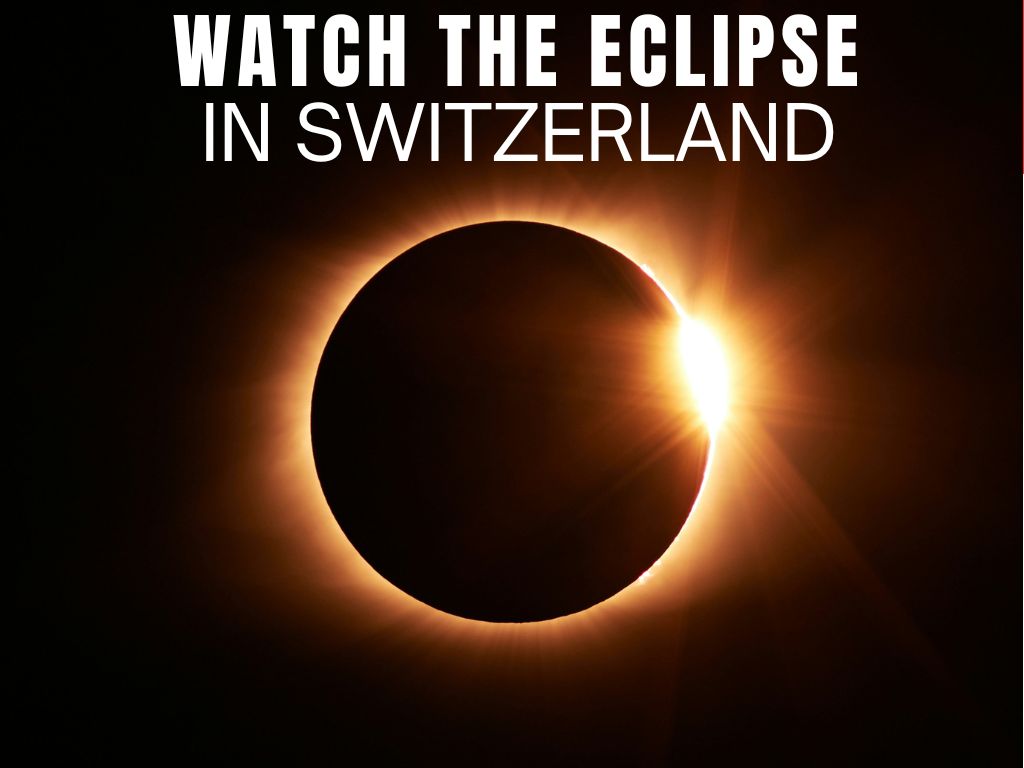
On Wednesday evening, the Moon will cover up to 93% of the Sun as seen from Switzerland. According to the Swiss Astronomical Society, an eclipse this size won’t happen here again until 2075. If you’re going to see it, this is genuinely the one to plan for.
The key facts
- When: Wednesday, August 12, starting shortly after 7:20 pm, peaking between 8:15 and 8:20 pm, ending around 8:45 pm as the sun sets.
- How much: Between 91% and 93% of the sun’s disc will be covered, depending on exact location in Switzerland.
- Direction to face: West-north-west, low toward the horizon, since the eclipse coincides with sunset.
- Where it’s best: The Swiss Astronomical Society specifically flags alpine valleys as a disadvantage, since surrounding peaks block the low western sky. The Plateau, the Pre-Alps, and mountain summits with a genuinely unobstructed western view are the recommended spots, weather permitting.
Where to actually go
Bernese Oberland: Niesen (with an organized event)
The Niesen cogwheel railway is running a dedicated eclipse evening on Wednesday, with departures every 30 minutes up to Niesen Kulm and an evening ticket rate of CHF 32 round trip.
The last ascent is at 7:30 pm, and the railway’s own schedule lines up with the event almost exactly: first contact at 7:25 pm, maximum coverage at 8:18 pm, sunset at 8:48 pm.
Seating in the mountain restaurant is limited and the full buffet is already sold out, so warm clothing for watching outside is worth packing, but a small number of certified ISO 12312-2:2015 eclipse glasses will be sold on site for CHF 2 each.
Train tickets aren’t reservable in advance and aren’t date-specific, so arriving at the valley station with some time to spare matters more than booking ahead.
Central Switzerland: Stanserhorn (with an organized event)

The Stanserhorn cable car, the open-top CabriO, is running special evening rides too, with the mountain open from 5 pm to 11 pm and departures continuing until 10 pm going up and 11 pm coming back down.
The summit sits above Lake Lucerne with a genuinely open outlook, though the sun sets behind Pilatus shortly after the eclipse’s maximum around 8:18 pm, worth knowing if catching the actual sunset moment matters.
As with Niesen, ISO-certified eclipse glasses (the on-site brand is Bresser) are sold at the summit shop for CHF 2, and the restaurant serves warm food until around 9 pm. These are weather-dependent runs, confirmed around noon the day before on the Stanserhorn website, so it’s worth checking before heading out if the forecast looks uncertain.
Central Switzerland: Rigi

** FREE with the Swiss Travel Pass
Known as the “Queen of the Mountains” for its panoramic, largely unobstructed views in multiple directions,
Rigi is a legitimate option for this event as well, reachable by cogwheel railway rather than requiring a hike.
Near Zurich: Uetliberg

Want To Save This For Later?
Zurich’s own city-edge viewpoint, easily reached by train, with an open 360-degree panorama when you are up the tower, over the Plateau toward the west.
No car needed, which makes it the simplest option on this list for anyone based in or near Zurich.
Near Bern: Gurten

A short funicular ride from central Bern, Gurten’s summit offers a wide, open view over the Bernese Plateau, one of the more accessible high points in the region on a weekday evening.
The Jura ridge: Chasseral, Weissenstein, or La Dôle
The Jura mountains run lower and more open than the Alps, which makes their ridgeline genuinely good for a clear western horizon.
Chasseral (above Neuchâtel and Biel), Weissenstein (above Solothurn), and La Dôle (above Nyon) are all established panorama viewpoints already popular for sunset watching, which is exactly the sightline this eclipse needs. Signal de Bougy, a lower hilltop above Lake Geneva near Nyon, is a good alternative for anyone who wants elevation without a full summit hike.
⚠️ How to actually watch it safely ⚠️
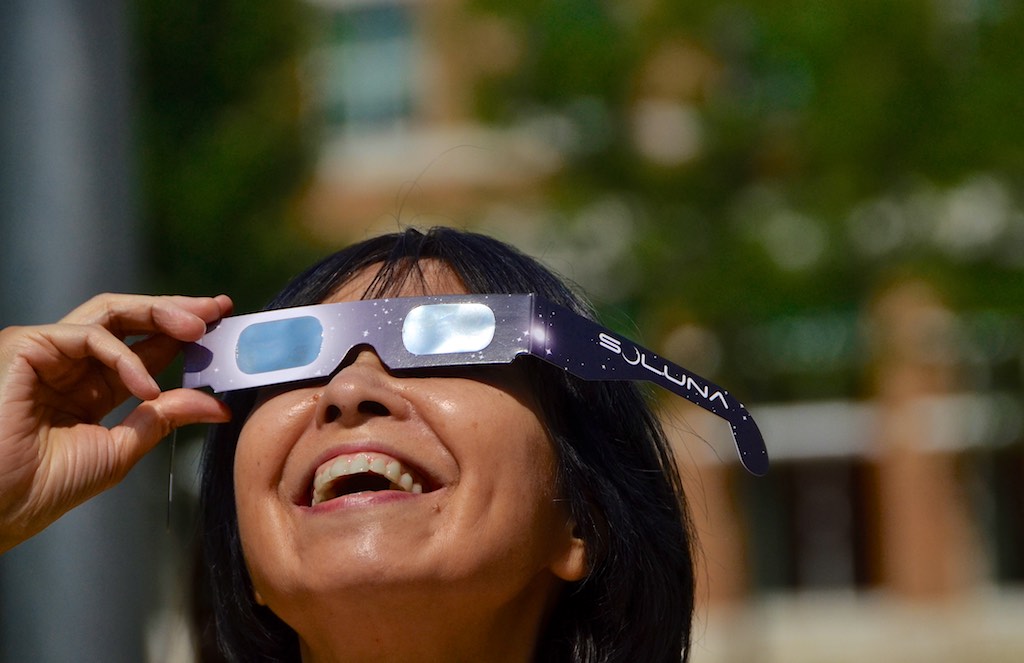
This part matters more than the location. Looking directly at the sun, even mostly covered, can cause permanent retinal damage, and this holds true throughout the entire event, not just at the point of maximum coverage. Regular sunglasses, however dark, don’t provide adequate protection.
The Federal Office of Public Health recommends solar eclipse glasses certified to the ISO 12312-2:2015 standard and carrying the CE mark, available from opticians and some pharmacies ahead of Wednesday.
Anyone planning to photograph it needs a proper solar filter fitted over the camera or phone lens too, since binoculars, telescopes, and camera lenses concentrate sunlight and make direct viewing through them more dangerous, not less.
While you’re out there – See the meteor shower!
The Perseid meteor shower peaks the same night, so anyone staying out past the eclipse has a second reason to keep looking up. A partial lunar eclipse follows later in the month, on August 28, visible across much of Europe in the hours before dawn.
Are you heading out for this one, and where?
Tell us in the comments, and if the weather doesn’t cooperate where you are, someone else’s spot might be worth chasing.