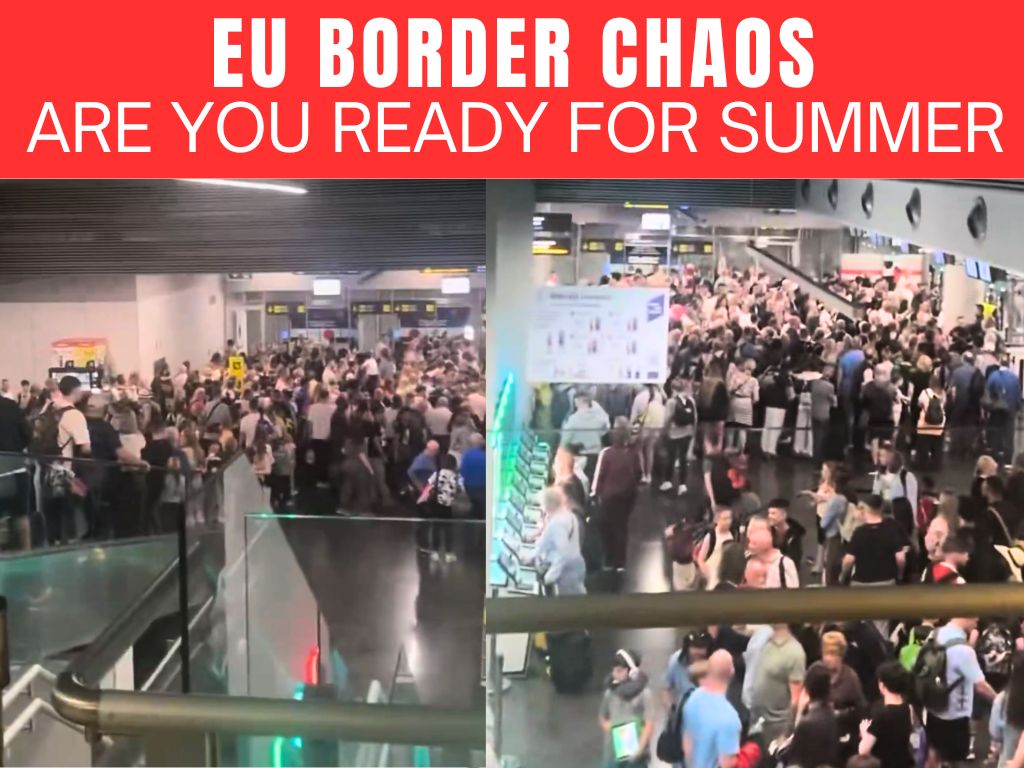
If you have plans to fly into Europe’s Schengen Area anytime soon, you might want to pack an extra dose of patience. And maybe a sleeping bag.
The European Union’s Entry/Exit System (EES) officially became 100% mandatory and fully operational across all 29 Schengen countries on April 10, 2026.
While it sounds great on paper (a high-tech, digital upgrade to replace those old ink passport stamps), the real-world rollout has been marred by hours-long bottlenecks, malfunctioning kiosks, and missed flights.
👉👉 🇨🇭 Switzerland seems to have things more or less under control, for now. With the summer peak still weeks away, this could definitely change.
🇪🇺 But this is what has been happening elsewhere in Europe…
📸 CNN’s Clarissa Ward Misses Her Flight
You know a travel system is struggling when seasoned, international war correspondents start complaining about airport security lines.
Just this week, CNN’s Chief International Correspondent Clarissa Ward posted the above viral Instagram reel showing the absolute chaos at Lisbon’s Humberto Delgado Airport.
After enjoying hours in a labyrinth of biometric lines, she missed her flight entirely and had to wait six hours for the next one.
“At this line, you have to use a machine, and then depending on the results of that machine, you get into another big line, or you go on to use yet another machine… This is about thousands and thousands of people who are basically going through complete insanity. The system doesn’t work.” > — Clarissa Ward, CNN
Her experience isn’t an isolated incident. Airlines and airport groups are sounding the alarm that the worst is yet to come as we head into the peak summer travel season.
🛠️ What is the EES (And why is It Causing Delays?)
The EES is an automated IT system that tracks short-stay travelers from non-EU countries (including the UK, US, Canada, and Australia) every time they cross a Schengen border.
Want To Save This For Later?
Instead of a quick passport stamp, your first entry under the system requires you to:
- Scan your passport at a dedicated digital kiosk.
- Provide a full set of fingerprints.
- Have a biometric facial image captured.
While the actual processing only takes about 90 to 120 seconds per person, multiplying that by hundreds of passengers on a packed transatlantic flight creates a massive compounding bottleneck. To make matters worse, early glitches like incompatible e-gates for UK/US passports and broken scanners have forced border agents to pull passengers back into manual lanes.
📍 The Current Delay Hotspots
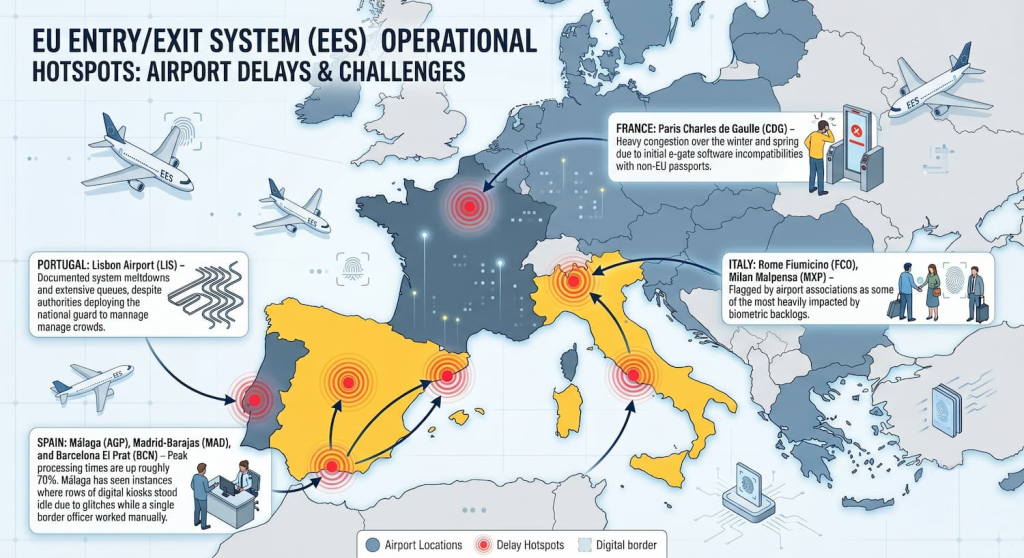
Disruption has been widespread, but southern European holiday hubs and massive transit ports are bearing the brunt of the chaos. Peak wait times of 2 to 4 hours (and sometimes up to 6 hours) have been regularly documented at the following locations:
- Portugal: Lisbon Airport (LIS) – Documented system meltdowns and extensive queues, despite authorities deploying the national guard to manage crowds.
- Spain: Málaga (AGP), Madrid-Barajas (MAD), and Barcelona El Prat (BCN) – Peak processing times are up roughly 70%. Málaga has seen instances in which rows of digital kiosks stood idle due to glitches, while a single border officer worked manually.
- France: Paris Charles de Gaulle (CDG) – Heavy congestion over the winter and spring due to initial e-gate software incompatibilities with non-EU passports.
- Italy: Rome Fiumicino (FCO) and Milan Malpensa (MXP) – Flagged by airport associations as some of the most heavily impacted by biometric backlogs.
✈️ How to Survive the EES Chaos This Summer
Airlines are pushing the EU to temporarily waive or relax biometric requirements during peak summer surges, but for now, the rules stand. If you are heading across the pond, here is how you can mitigate the headache:
- Arrive (Much) Earlier: The standard 2-hour window for short-haul or 3-hour window for long-haul flights isn’t cutting it right now. Hubs like Paris and Málaga are actively advising passengers to pad their arrival times significantly.
- Avoid the Morning Wave: If you have flexibility in your booking, try to avoid arriving at major European hubs between 6:00 AM and 10:00 AM, when massive waves of international long-haul flights land simultaneously.
- Pad Your Connections: If you are transiting through mega-hubs like Frankfurt or Amsterdam to get to an onward Schengen destination, aim for a minimum 3-hour layover to account for border queues.
- Look for the Mobile App: Download the official “Travel to Europe” mobile app. While not yet fully integrated in every EU state, it allows you to pre-register your passport details and photos up to 72 hours before you fly, which can drastically reduce your time at the airport kiosk.
🔗 Sources Used
- Holiday Extras – What’s Happening with the EU’s Entry Exit Scheme?
- GOV.UK – EU Entry/Exit System Official Guidance
- European Union – Official EES Migration and Home Affairs Policy
- Wego Travel Blog – EES Border Queues in 2026 & How to Beat Them
- Travel Tomorrow – European Border System Causing “Complete Insanity” at Lisbon Airport
- Portugal Resident – “The System Doesn’t Work” – CNN Chief International Journalist at Lisbon Airport