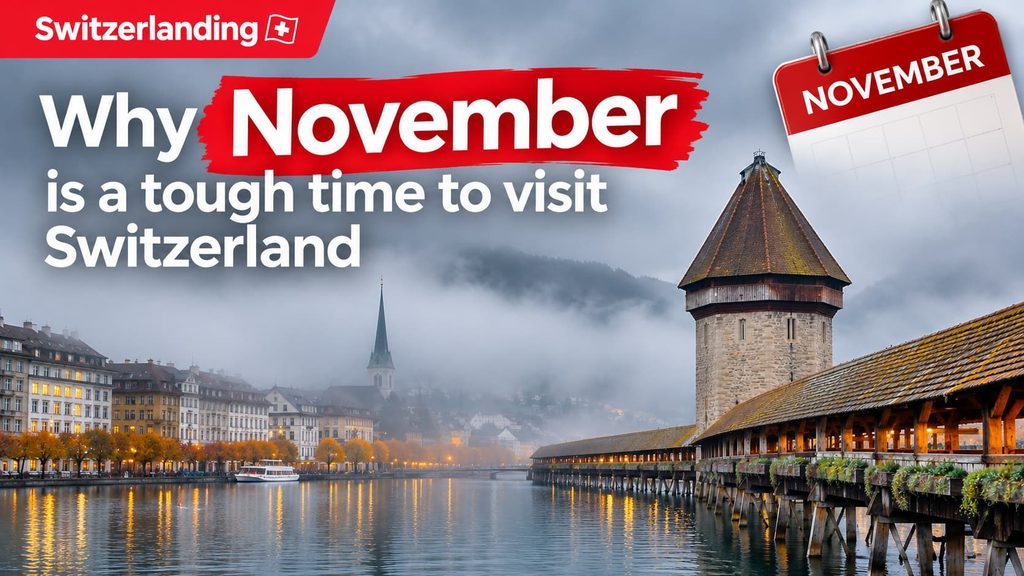
Switzerland is an incredible country to visit. But there is one month I generally recommend avoiding, especially if you’re planning your first trip.
November.
It’s not that Switzerland suddenly becomes unattractive. The mountains are still there, the lakes are beautiful, and the cities have plenty to offer.
The problem is that November falls into an awkward period between autumn and winter.
- The weather can be downright depressing.
- The colorful autumn foliage has mostly disappeared
- The ski season hasn’t properly started in many resorts
- Some mountain attractions are closed (MORE ON THAT BELOW 👇👇👇)
And this isn’t just a personal opinion.
When you look at the official climate data from MeteoSwiss, Switzerland’s national weather service, you quickly understand why November is a difficult month for tourists.
Let’s look at the numbers and what they actually mean for your trip….
1. November has remarkably little sunshine
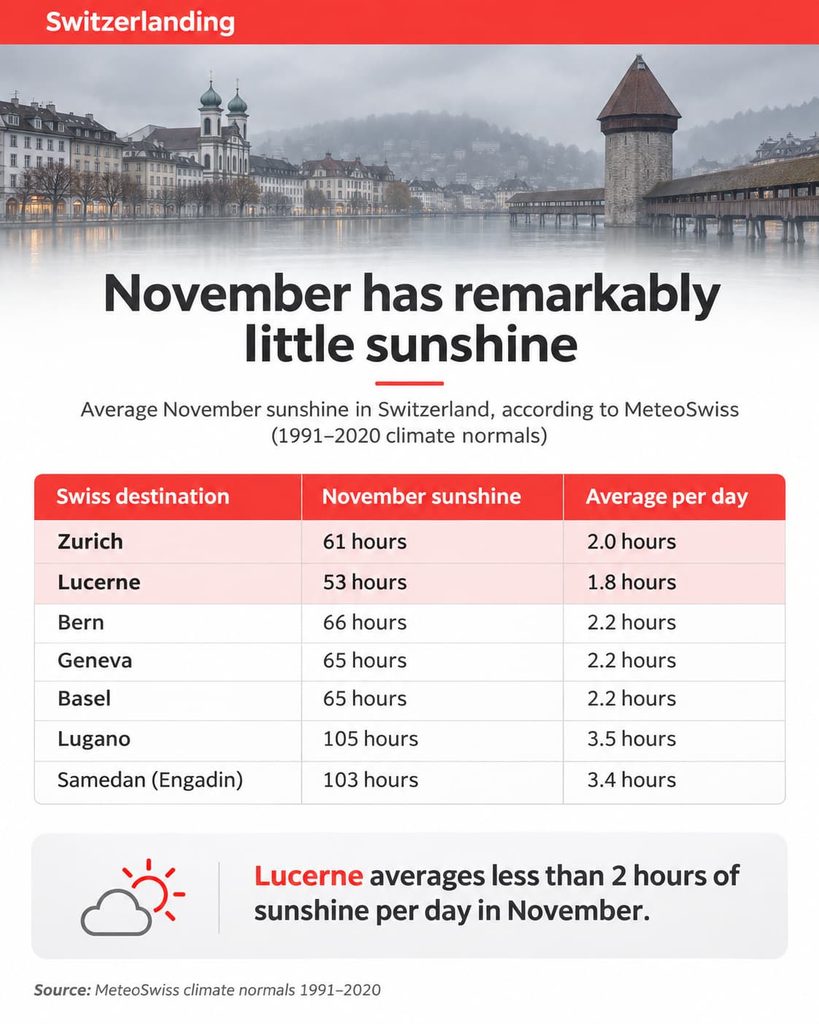
One of the biggest problems with visiting Switzerland in November is the lack of sunshine.
According to MeteoSwiss, the average amount of sunshine in November is surprisingly low across much of the country.
Here are the official monthly averages from the 1991–2020 reference period.
| Swiss destination | November sunshine | Average per day |
|---|---|---|
| Zurich | 61 hours | 2.0 hours |
| Lucerne | 53 hours | 1.8 hours |
| Bern | 66 hours | 2.2 hours |
| Geneva | 65 hours | 2.2 hours |
| Basel | 65 hours | 2.2 hours |
| Lugano | 105 hours | 3.5 hours |
| Samedan (Engadin) | 103 hours | 3.4 hours |
Source: MeteoSwiss climate normals, 1991–2020. Average daily sunshine is calculated by dividing the monthly total by 30 days.
Let that sink in for a moment.
Lucerne, one of Switzerland’s most popular tourist destinations, averages less than two hours of sunshine per day during November.
Zurich is only slightly better.
And before you assume that means two beautiful hours of sunshine every afternoon, remember that these are monthly averages.
You could experience several days of grey skies followed by a few sunny days. Sunshine is not distributed evenly throughout the month.
How does November compare with other months?
Consider Zurich, where MeteoSwiss records the following average monthly sunshine totals:
| Month | Average sunshine |
|---|---|
| July | 229 hours |
| October | 109 hours |
| November | 61 hours |
That means Zurich receives approximately 73% less sunshine in November than in July, based on total monthly sunshine hours.
Even compared with October, November has about 44% fewer sunshine hours.
And that’s a substantial difference when you’ve travelled halfway around the world hoping to see Switzerland at its best.
2. Fog can hide the very scenery you came to see
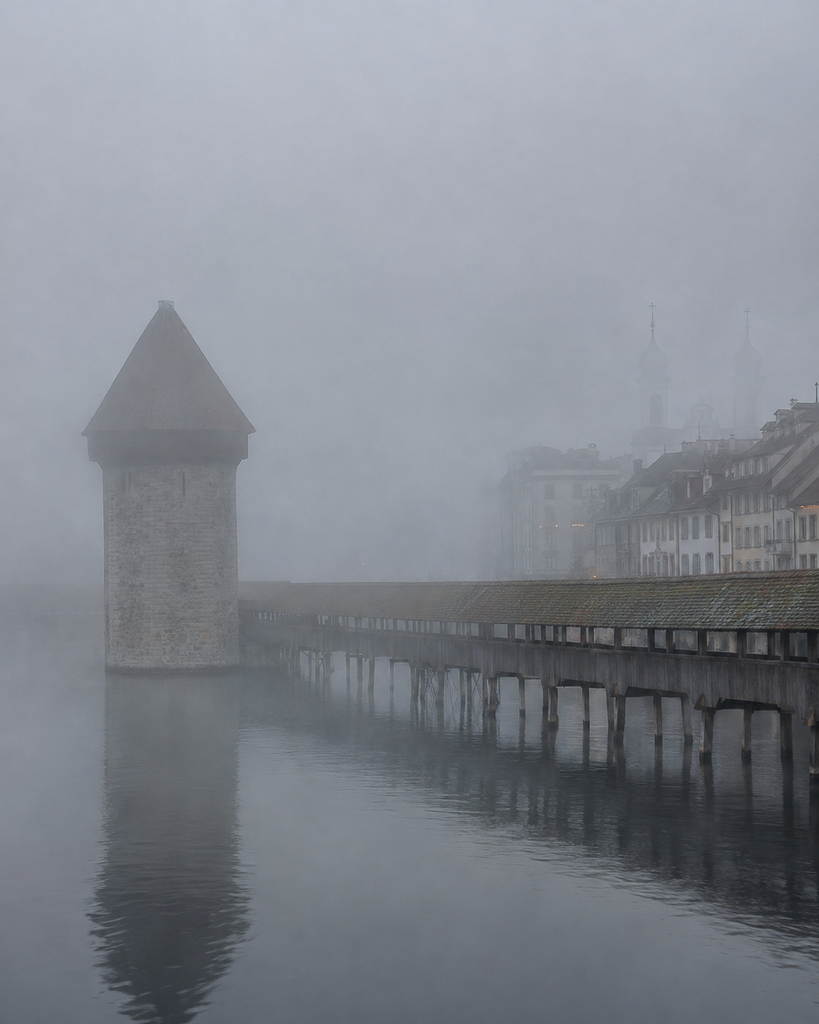
There’s another reason November can be frustrating.
Fog.
Or, more specifically, the persistent low cloud known in Switzerland as Hochnebel.
This weather phenomenon is particularly common over the Swiss Plateau, the lower region between the Jura Mountains and the Alps. The area that covers
- Zurich
- Lucerne
- Bern
- Lake Geneva
The mountains might be enjoying beautiful sunshine above the cloud layer, (see below) while the cities and valleys below remain cold and grey.
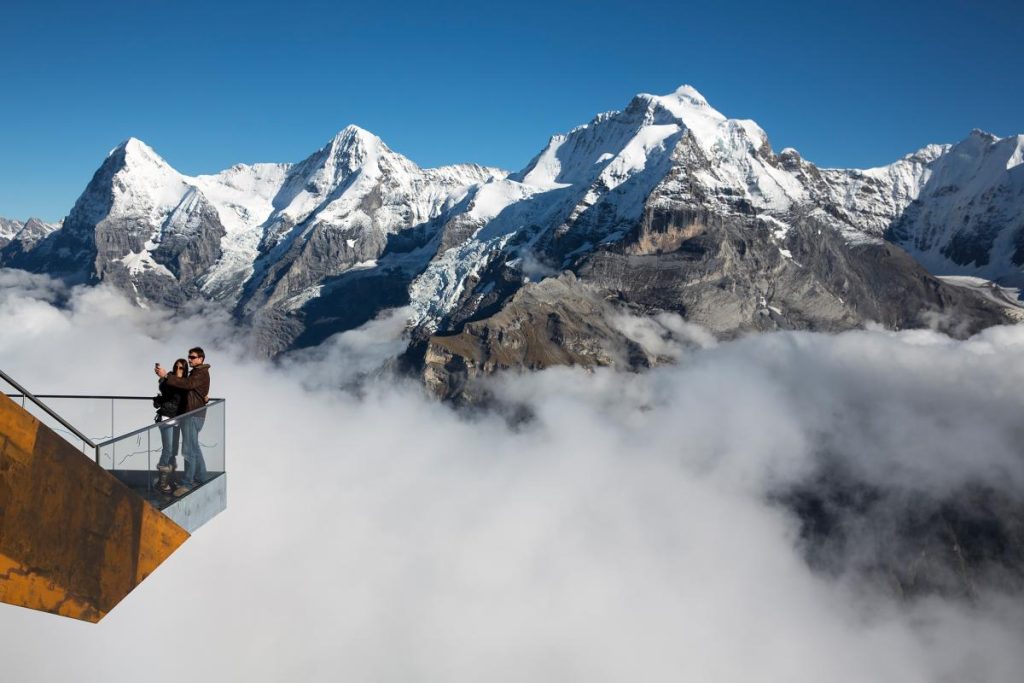
One climatological study found that November, December and January typically experience around 3.5 to 5 days per month when fog or low cloud persists throughout the daylight hours at the locations studied.
That doesn’t include every shorter fog event or ordinary cloudy day. And it highlights one of the biggest risks of a November trip.
Imagine visiting Lucerne and planning to enjoy the views of Mount Pilatus or Mount Rigi.
On a clear day, the scenery is magnificent. On a foggy November day, you might barely see across the lake.
One important exception, however. If you can travel above the fog layer, you might enjoy brilliant sunshine and spectacular views over a sea of clouds.
The trick is knowing where the cloud ceiling is and whether the mountain transport you need is operating.
3. November is cold, but not necessarily snowy
Another misconception is that visiting Switzerland in November means experiencing a magical winter wonderland.
Unfortunately, it doesn’t always work that way. November is a transition month.
| Destination | Celsius (°C) | Fahrenheit (°F) |
|---|---|---|
| Zurich | 4.9°C | 40.8°F |
| Bern | 4.2°C | 39.6°F |
| Geneva | 6.0°C | 42.8°F |
| Basel | 6.0°C | 42.8°F |
| Engelberg | 2.5°C | 36.5°F |
| Lugano | 8.4°C | 47.1°F |
| Samedan | -2.1°C | 28.2°F |
Temperatures have fallen significantly compared with September and October, but many lower-altitude destinations haven’t developed a reliable snow cover.
According to MeteoSwiss, the average November temperatures are:
Source: MeteoSwiss, November climate normals 1991–2020. These are monthly mean temperatures, not average daytime highs.
So what does that mean for tourists?
In places like Zurich, Lucerne and Interlaken, you may encounter cold rain, damp streets, grey skies and chilly mornings rather than picturesque snowy landscapes.
Higher in the mountains, fresh snow may already be falling. But a few days of snowfall don’t necessarily mean winter activities are fully operational.
In fact, November can produce a frustrating combination: too cold for comfortable summer sightseeing, but not snowy enough for the winter holiday you imagined.
4. Rain and unsettled weather can complicate your plans
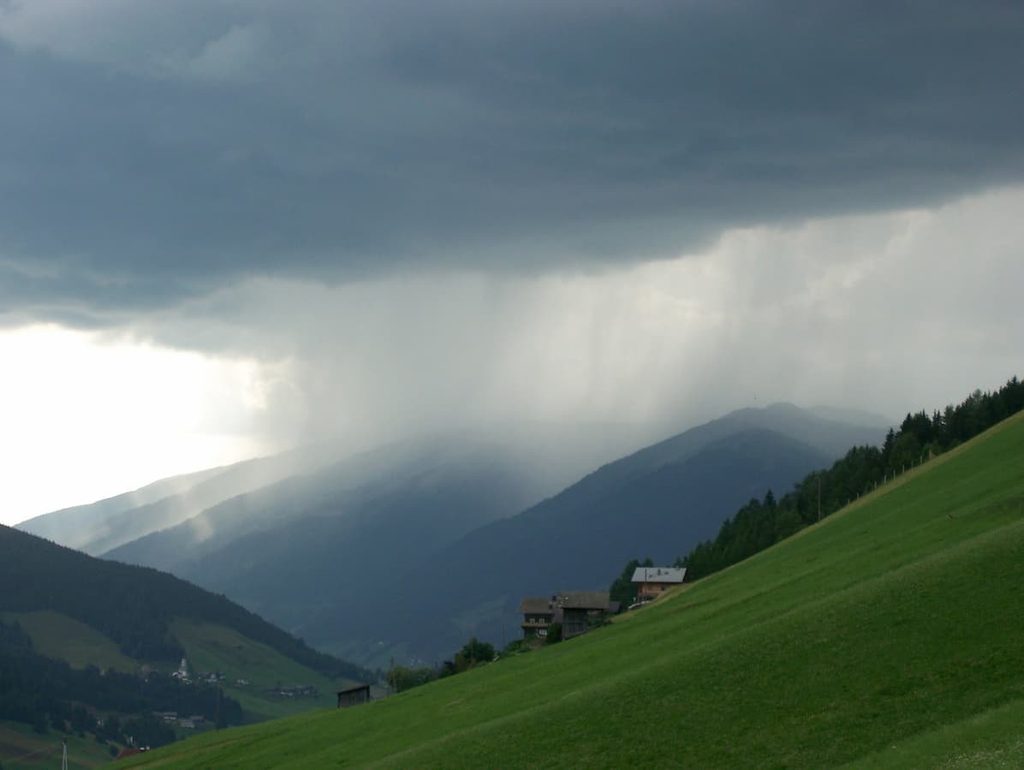
November isn’t necessarily Switzerland’s wettest month.
In fact, several Swiss destinations receive more precipitation during summer, when thunderstorms contribute substantially to monthly totals.
But that doesn’t mean November is pleasant. That is where reading “average rainfall” can be misleading :>
The combination of low temperatures, limited sunshine, rain, occasional snow and persistent clouds can make outdoor sightseeing uncomfortable.
MeteoSwiss records the following average November rainfall:
| Destination | November precipitation (mm) | Inches (in) |
|---|---|---|
| Zurich | 76 mm | 2.99 in |
| Bern | 77 mm | 3.03 in |
| Geneva | 89 mm | 3.50 in |
| Basel | 65 mm | 2.56 in |
| Engelberg | 102 mm | 4.02 in |
| Lugano | 167 mm | 6.57 in |
These totals vary considerably by location and from year to year.
Importantly, precipitation totals alone don’t tell you how many days will be rainy or overcast.
A month can be relatively dry while still having long periods of grey skies. For tourists, that’s a significant distinction.
You might not experience particularly heavy rain, but you could still spend much of your visit under a blanket of cloud.
5. The days are getting much shorter
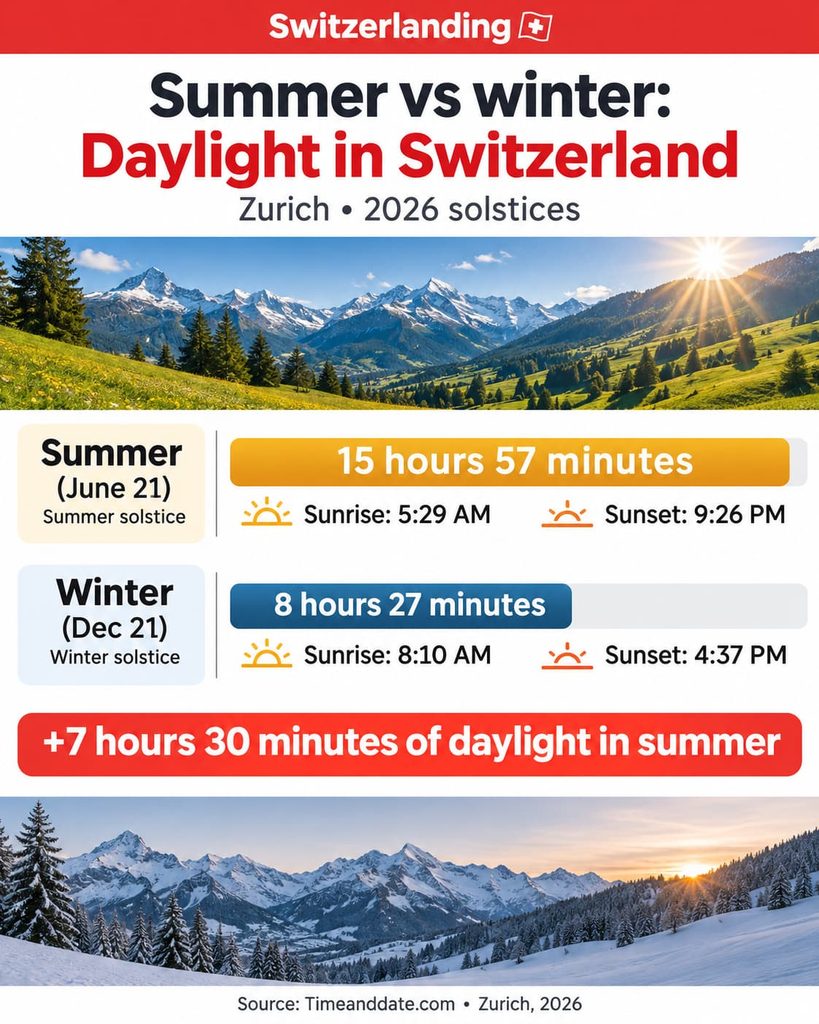
Even if you experience beautiful weather, November presents another challenge.
There simply isn’t much daylight.
In Zurich, for example, the sun rises and sets at approximately these times during November 2026:
| Date | Sunrise | Sunset |
|---|---|---|
| November 1 | 7:09 AM | 5:09 PM |
| November 15 | 7:30 AM | 4:50 PM |
| November 30 | 7:50 AM | 4:37 PM |
Source: Timeanddate.com, Zurich sunrise and sunset calculations.
By the end of November, Zurich has less than nine hours of daylight.
And if you’re traveling into the mountains, you’ll need to allow time for trains, cable cars, walking and sightseeing.
For example, a trip from Interlaken to a mountain viewpoint can easily involve several transport connections.
When the sun disappears before 5 PM, your sightseeing window shrinks considerably. In mountain valleys, it can set even earlier!
During summer, you can spend the entire day exploring and still enjoy a beautiful evening beside a Swiss lake.
In November, you might be heading back to your hotel before you’ve finished exploring.
6. Some of Switzerland’s best mountain attractions are closed
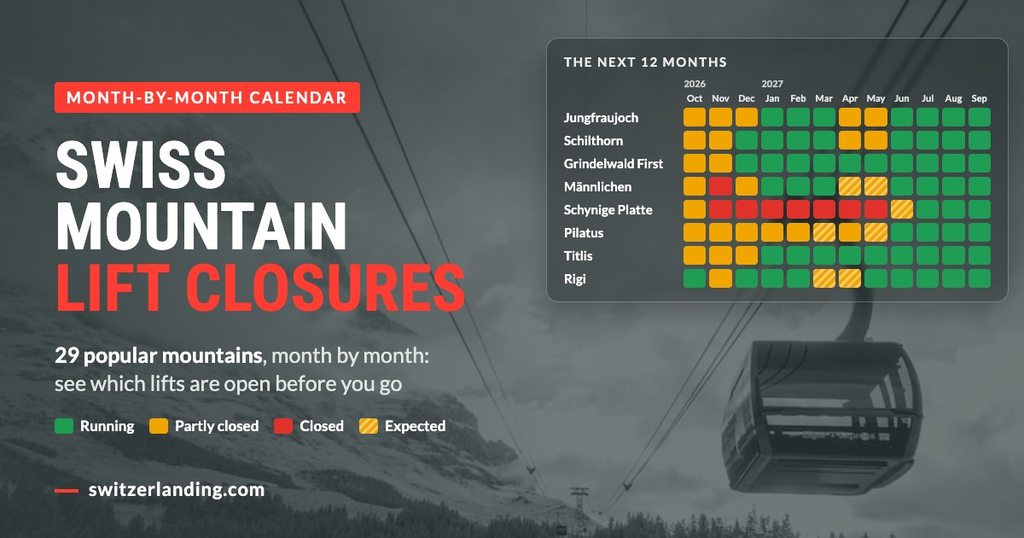
This is another major reason I hesitate to recommend November.
Many mountain railways and cable cars operate seasonally or undergo maintenance between the summer and winter tourism seasons.
November is a particularly common period for these interruptions.
And sometimes the closures affect exactly the attractions tourists are most excited about.
Consider these examples from 2026.
👉👉 SEE WHICH MOUNTAINS ARE OPEN
Schynige Platte
The historic mountain railway above Interlaken operates during the warmer months, generally from June to October. That means visitors in November miss out on this popular mountain excursion and its panoramic walking trails.
Brienzer Rothorn
The historic steam railway above Lake Brienz ended its regular 2026 season on October 25. Another spectacular scenic excursion that isn’t available for a typical November visit.
Mount Pilatus
The situation can be more complicated for attractions with several ways to reach the summit.
In 2026, the gondolas and cable car from Kriens to Pilatus were closed for maintenance from October 19 to November 27. The cogwheel railway from Alpnachstad remained the alternative, operating until November 29, subject to conditions.
So Pilatus wasn’t completely inaccessible, but the options were restricted.
👉👉 The important takeaway is that November requires much more careful planning.
Not every mountain excursion is closed. Popular attractions such as Jungfraujoch, Gornergrat and Mount Titlis can remain accessible, although individual services may be interrupted.
But don’t assume every cable car, mountain railway, or viewpoint will be available. Always check the official operating dates before planning your itinerary.
7. It’s too late for many autumn activities and too early for most winter activities

One of November’s biggest problems has nothing to do with temperature averages. It’s simply the timing.
September and October can be wonderful months for exploring Switzerland.
The forests change colour, the mountain scenery is spectacular, and many hiking trails and summer attractions are still accessible. But by November, much of that seasonal beauty has faded.
The golden larch trees in the Engadin have generally lost their needles. Alpine meadows have turned brown. Many mountain restaurants and seasonal attractions have finished their summer operations.
And then there’s winter.

December brings the beginning of the main winter tourism season in many resorts, with skiing, Christmas markets, festive decorations and other seasonal activities. November falls awkwardly between them.
You could arrive in Zermatt or Grindelwald hoping to enjoy the mountains, only to find hiking conditions deteriorating while many winter sports facilities haven’t opened yet.
Of course, conditions vary by altitude, resort and year.
Some high-altitude ski areas can operate in November, and sunny lower-altitude walks may still be possible.
But November offers fewer dependable outdoor options than a typical summer or established winter season.
8. Is there anything good about visiting Switzerland in November?
Absolutely. November isn’t completely without its advantages.
For starters, it’s generally a quieter period for tourism in many destinations. You may find better accommodation availability and potentially lower prices than during peak summer or the Christmas holiday period.
The major cities are also enjoyable throughout the year. Zurich, Basel, Bern and Geneva have excellent museums, galleries, restaurants and historic old towns.
And southern Switzerland can provide a different experience. MeteoSwiss records an average of 105 sunshine hours in Lugano during November, substantially more than Zurich or Lucerne.
The Valais (Zermatt) and Engadin can also enjoy beautiful autumn weather, especially when low cloud covers the Swiss Plateau. My landlord goes there all the time!
Then there’s the festive season.
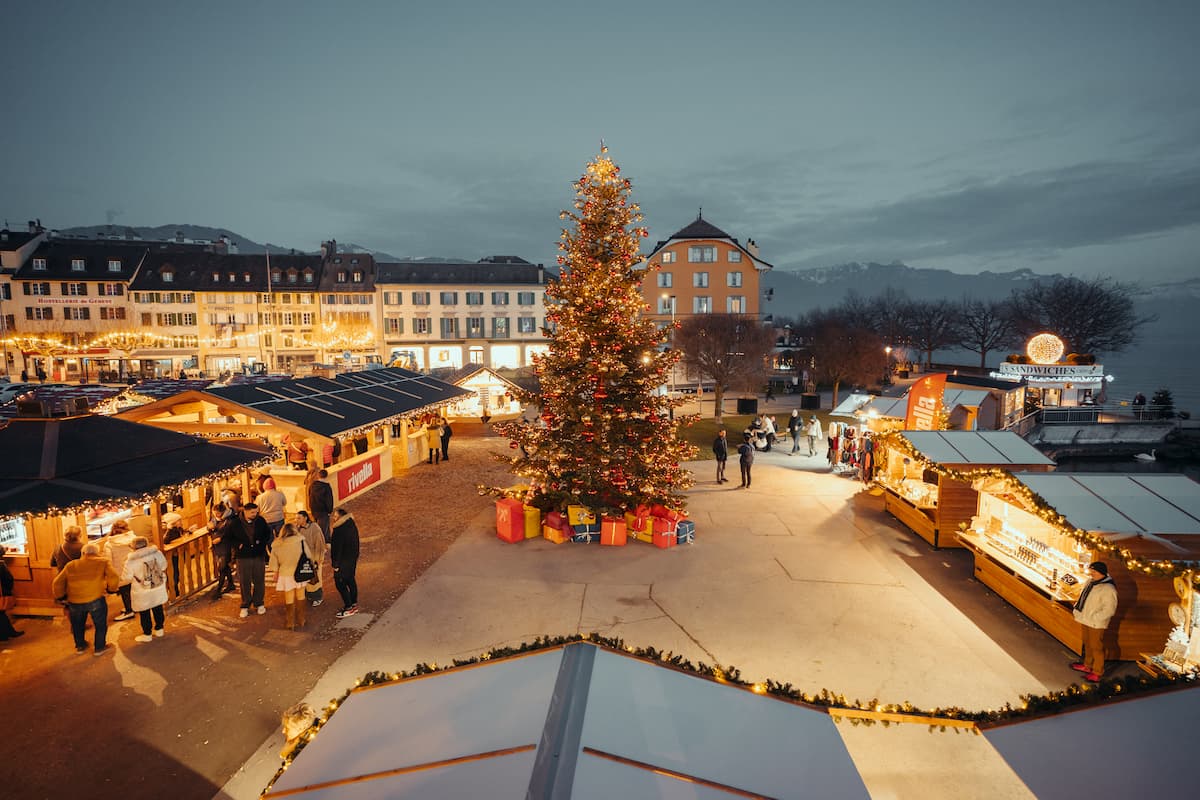
Towards the end of November, Switzerland begins transforming into a Christmas destination.
In 2026, many of Zurich’s major Christmas markets open on November 19.
That makes the final part of November considerably more attractive for visitors interested in Christmas lights, market stalls, fondue and festive atmosphere.
If that’s the focus of your trip, late November can work very well.
But if you’re hoping for green valleys, turquoise lakes, alpine hikes and consistently spectacular mountain views, I would choose a different month.
10. When should you visit Switzerland instead?

The best time depends on what you want to experience.
For a classic first-time Switzerland trip, I generally recommend June through September.
During these months, you have longer daylight hours, greater access to mountain attractions, and far more opportunities for hiking and outdoor sightseeing.
September is particularly attractive if you prefer slightly cooler temperatures and fewer visitors than during the summer school holidays.

For autumn colours, early to mid-October can be spectacular, although the timing of the foliage and seasonal closures varies with altitude and weather.
For a winter experience, consider January, February or early March, particularly if skiing and snow-covered alpine scenery are priorities.

And if Christmas markets are your main reason for visiting, late November and December can be excellent choices. Just check the individual market dates.
No month guarantees perfect weather.
But choosing a season that matches the activities you want to enjoy will make a significant difference.
So, is November really the worst month to visit Switzerland?
It depends on your expectations.
If you’re visiting for museums, food, city breaks, quiet streets or Christmas markets towards the end of the month, November can be perfectly enjoyable.
But if you’re planning a once-in-a-lifetime Switzerland holiday built around scenic train journeys, mountains, lakes, hiking, and unforgettable views, November would be near the bottom of my list.
Sources and climate data
The weather statistics above are primarily based on the official MeteoSwiss 1991–2020 climatological reference period. The figures are long-term monthly averages, not predictions for an individual trip.
- MeteoSwiss: Climate normals and open data
- MeteoSwiss: November 2024 climate bulletin, including November temperature, sunshine and precipitation normals
- MeteoSwiss: July 2024 climate bulletin
- MeteoSwiss: October 2025 climate bulletin
- MeteoSwiss: November 2025 climate bulletin
- MeteoSwiss: Fog and low stratus climatological study
- Pilatus: Official railway and cable car timetable
- Bern tourism region: Mountain railway operating seasons
- Zurich Tourism: Christmas markets
- Timeanddate: November 2026 sunrise and sunset in Zurich
Seasonal attraction schedules refer to the published 2026 operating dates and should be checked again for future years.