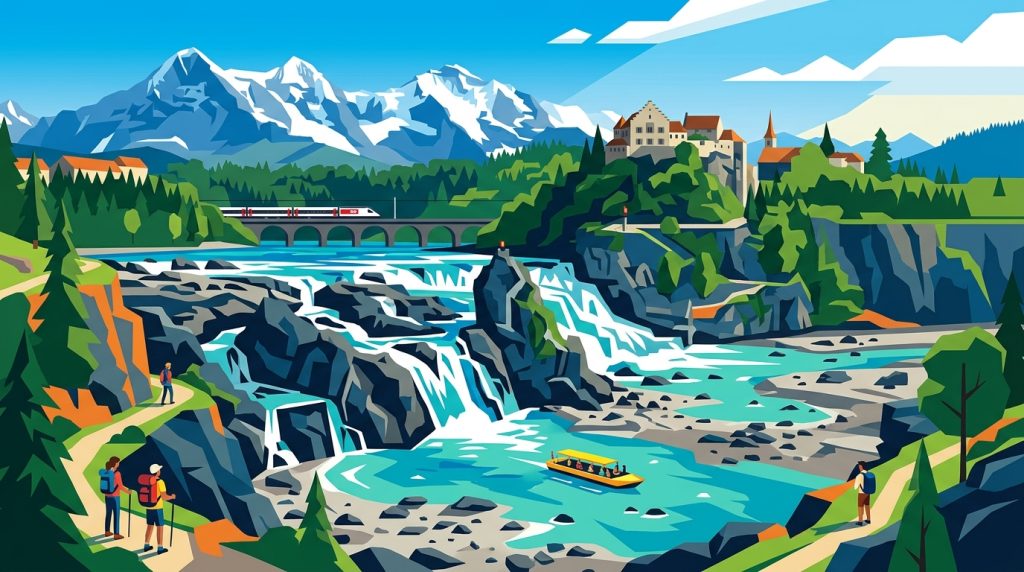
You know the Rhine Falls. That glorious, thundering cascade, Europe’s most powerful waterfall, a Swiss postcard come to life. Normally, you can feel its raw energy vibrating through the ground, the spray misting your face even from the viewing platforms. Well, lately, it’s looking a little… quieter.
Right now, the Rhine Falls is flirting with a historic record low water level. We’re talking levels not seen in over a century, since the 1921 dry spell.
It’s a stark visual, a powerful natural wonder brought low by the relentless heat and drought gripping much of Europe.
What’s Happening?
The numbers tell the story. The flow rate, typically around 370 cubic meters per second in summer, has plummeted. We’re talking a fraction of that.
The rocks that usually hide beneath a churning torrent are now exposed, dry and sun-baked. The mighty roar is more of a persistent gurgle. It’s still moving, of course, but it lacks its usual swagger.
The reason is simple: prolonged heat, minimal rainfall, and, crucially, little melting snow from the Alps. The Rhine, fed by these snowpacks and glaciers, simply isn’t getting its usual supply.
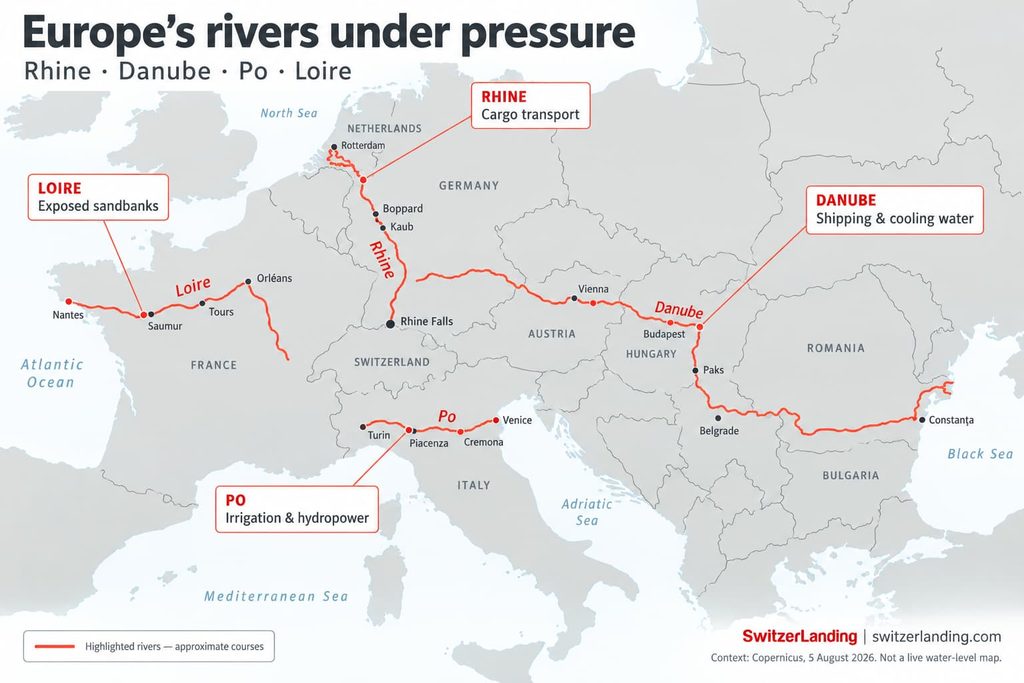
This isn’t just a Swiss issue; it’s a broad continental problem, making headlines for rivers like
- the Po
- the Danube
- the Rhine further downstream, where shipping has been severely impacted.
But here, at the Falls near Schaffhausen, the impact is dramatically visible.
Should You Still Go?
Want To Save This For Later?
Absolutely. Just adjust your expectations. While you won’t experience the full, majestic power we usually brag about, you’ll see something equally compelling: nature adapting and showing us a different facet of its beauty.
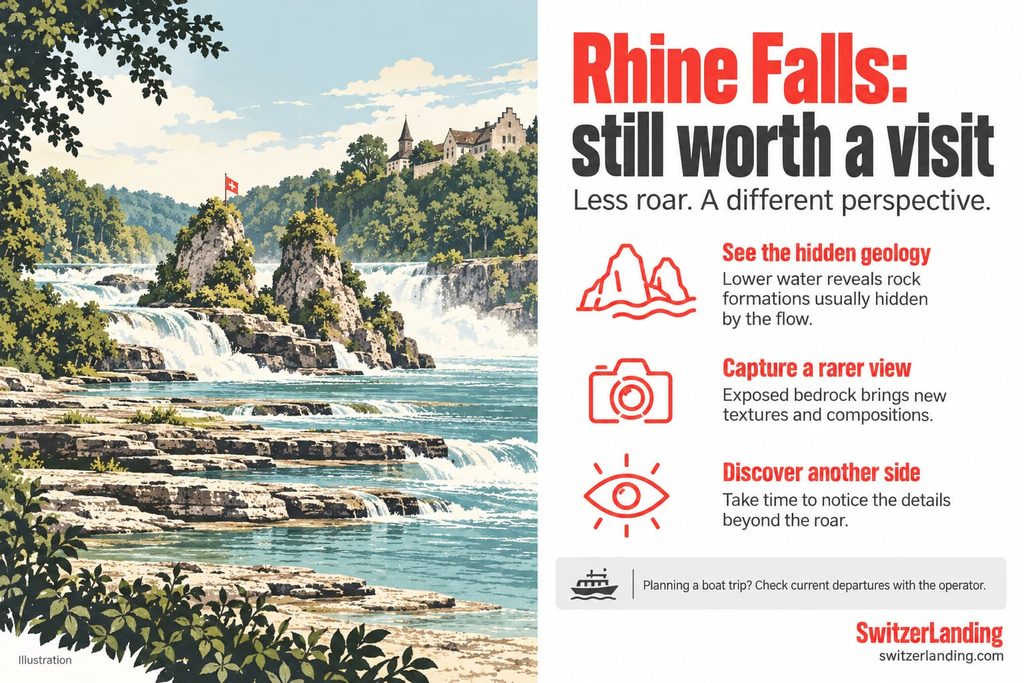
Think of it as a unique, temporary exhibition. You get an unprecedented view of the underlying rock formations, the amazing geology that normally remains hidden.
It’s a rare chance to truly see the bones of the beast. The boat trips that take you right up to the falls, or across to the rock in the middle, are still running. The experience will be different, perhaps less wet, but no less fascinating.
You might even hear the guides pointing out things they rarely get to show.
Photography opportunities are also, surprisingly, unique. Imagine capturing the falls with exposed bedrock, a landscape usually unseen. It’s a chance to document a moment in history.
Broader Implications
For us locals, and anyone watching the climate, it’s a stark reminder. These dry spells aren’t just an inconvenience; they highlight the fragility of our ecosystems and affect everything from hydropower generation to river transport. The Rhine’s health is vital to countless communities and industries.
Seeing the Rhine Falls in this state underscores the importance of water, a resource we often take for granted in Switzerland. It prompts reflection on our consumption, our agricultural practices, and the broader fight against climate change.
A Glimmer of Hope?
Of course, a good, long spell of rain would be welcome. A return to cooler temperatures, more precipitation – these are what the river needs to regain its strength.
For now, the Rhine Falls offers a different kind of spectacle. It’s not just a powerful waterfall; it’s a living barometer of our changing climate.
Go see it. It’s an unforgettable experience, perhaps more so now than ever, because it tells a story that resonates far beyond its rocky confines.