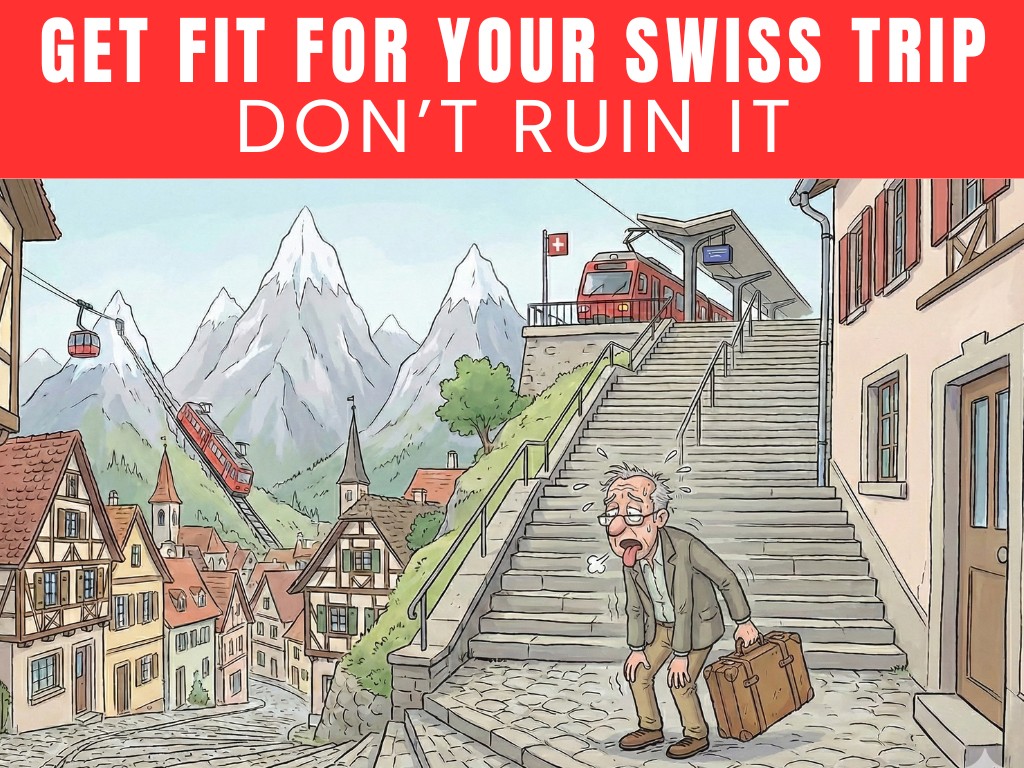
Switzerland is breathtaking: literally. If you want to enjoy the panoramas without losing your breath, it’s time to start training for those walks.
You don’t need to be a mountain climber, but you do need to be “European City Fit.”
In Switzerland, even “non-hikers” will easily clock 12,000 to 20,000 steps a day just by navigating train stations, exploring Old Towns, walking to lakefronts, or doing short mountain walks.
And given you want to make the most of your Swiss vacation…
Here is how to train your body for the Swiss lifestyle without ever hitting a hiking trail.
1. Building Up Your Step Count

In many car-focused cultures, the “door-to-door” lifestyle means you rarely walk more than a few hundred feet at a time.
In Switzerland, the walk from the train platform to the gondola entrance might be half a mile alone. So, to get yourself in shape for a visit to Switzerland, it pays to start preparing in advance.
👉👉 GRAB YOURSELF A FITNESS TRACKER LIKE THIS TO GET MOVING!
- The Increment Rule: Don’t jump from 2,000 steps to 15,000 overnight. Increase your daily count by 1,000 steps each week leading up to your trip.
- The “Long Walk” Simulation: Once a week, go for a continuous 60-minute walk. This isn’t about speed; it’s about time on your feet. Swiss sightseeing often involves 3–4 hours of being “up and about” without a long sit-down break.
| Week | Daily Step Target | Habit to Build |
| Week 1 | 5,000 steps | Park at the back of every parking lot. |
| Week 2 | 7,500 steps | Take a 15-minute walk after dinner. |
| Week 3 | 10,000 steps | Walk to errands within 1 mile of your house. |
| Week 4 | 12,000+ steps | One “Long Walk” (1 hour+) in your travel shoes. |
2. The “Train Station Sprint” (Stairs & Inclines)

Swiss public transport is world-class, but it isn’t always “flat.” You will encounter steep ramps, underground tunnels, and plenty of stairs when switching from a train to a mountain funicular or moving between platforms.
- The Training: Stop using the elevator and escalator. If you live in a flat area, find a local stadium or a multi-story parking garage.
- The Goal: Work up to climbing 4–5 flights of stairs comfortably while carrying a 10lb bag (simulating your daypack with water and souvenirs).
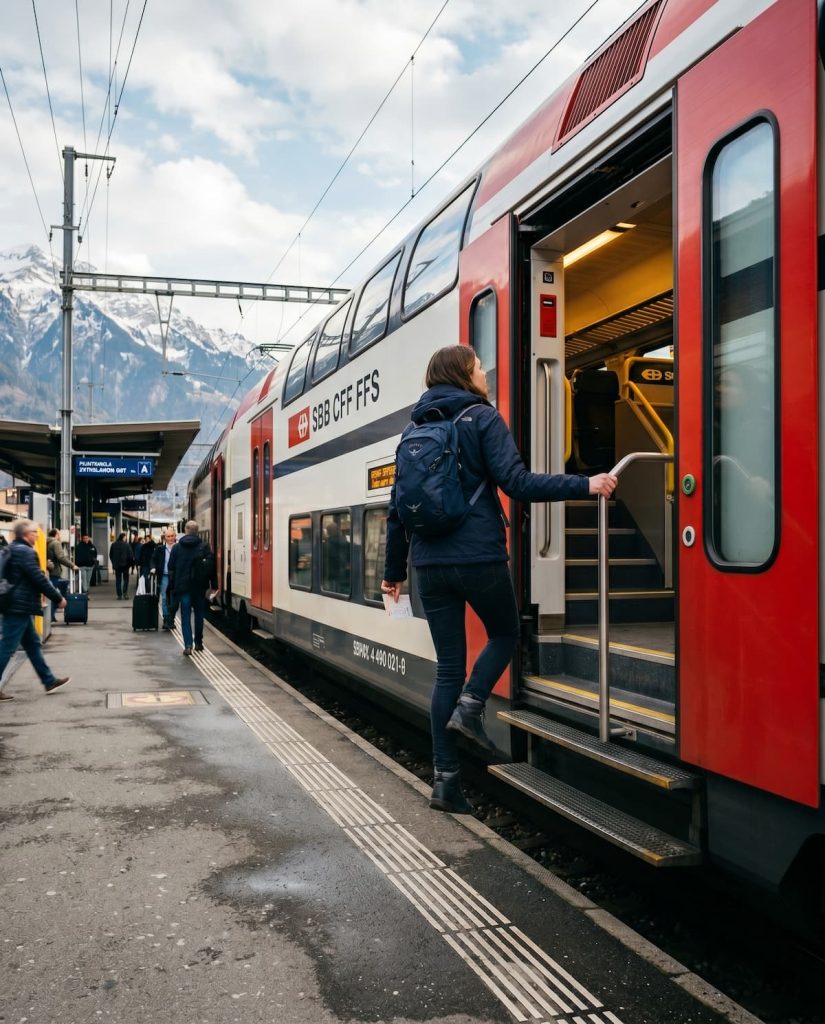
Also, make sure you can lift your suitcase up onto a train. The train pictured above is flat with the platform!
Want To Save This For Later?
BUT this is not always the case. Many smaller or older trains are many feet above the platform. So if your luggage weighs way over 30lbs/15kg, you are going to seriously struggle on trains.
3. The “Cobblestone Shuffle” (Ankle Stability)

Swiss Old Towns like Lucerne, Bern, and Zurich are paved with charming, uneven cobblestones. These are “ankle-rollers” for the uninitiated.
Sure, most people won’t have a problem, but it’s better to be safe than sorry!
- The Training: Practice walking on uneven surfaces like grass, sand, or gravel rather than just the treadmill or pavement.
- The Move: Practice single-leg balances. Stand on one foot while brushing your teeth (30 seconds per leg). This strengthens the tiny stabilizer muscles in your ankles that keep you steady on old stone streets.
4. Standing Endurance

These days, we all tend to sit too much.
During your visit to Switzerland, you’ll spend a surprising amount of time standing.
Even just on a typical day out: waiting for a bus or a boat, looking at a museum exhibit, or riding a standing-room-only gondola.
- The Training: If you have a desk job, use a standing desk for 2 hours a day.
- The Goal: Be able to stand still for 30–45 minutes without your lower back aching.
Pro Tip: The Gear Break-In

The biggest mistake tourists make is buying brand-new “walking shoes” a week before the trip.
Buy your shoes now. Wear them for your grocery runs and your neighborhood walks.
Also think about grip – if you are hiking in the mountains, you may encounter uneven terrain and your typical Nikes are not going to cut it.
👉👉 🥾 FIND THE BEST SHOES FOR YOUR WALKING STYLE (FOR SWITZERLAND)
Look for: Shoes with a “stiff” sole. Thin, flexible sneakers (like fashion Keds or Vans) will let you feel every single jagged cobblestone, which leads to foot fatigue very quickly.




Hey, Ashley. These are great trips. Based on my experience of navigating Berlin with a huge luggage in the past, I learned my experience the hard way and chose backpacks and tried my best to not over pack. My strength training came a long way in little hikes, running across platforms so to catch my connecting trains, walking from hotels to station with the 15 kgs backpack. I still had a little suitcase for my workwear (I didn’t want to spend time in ironing clothes) though. After reading your blog and articles on shoes I got myself Decathlon’s hiking shoes. Nothing fancy although I like my Sketchers walking shoes but my feet thanked Decathlon hiking shoes as it gave me better grip.