The Val-de-Travers, a picturesque valley in the Swiss canton of Neuchâtel, holds a surprising secret.
For 95 years, this region produced absinthe illegally, defying a national ban.
The local population openly celebrated in 2005 when the “Green Fairy” was finally legal again.
The Birth of the Green Fairy

Absinthe, often called “the Green Fairy,” has its historical roots in the Val-de-Travers.
Its story began in 1792 with Dr. Pierre Ordinaire, a French physician who developed a recipe for the anise-flavored spirit. A few years later, in 1797, Major Henri Dubied purchased the recipe.
Dubied and his son-in-law, H.L. Pernod, then opened the first absinthe distillery in Couvet in 1798. The Pernod Fils distillery, a major name in absinthe, followed in Pontarlier, France, in 1805. Absinthe quickly grew in popularity throughout the 19th century, especially among French artists and writers.
A Century of Prohibition
As absinthe’s popularity soared, concerns about its effects grew. Critics linked it to public drunkenness and “madness,” despite modern research suggesting its psychoactive properties beyond alcohol content were exaggerated.
A sensational murder case in 1905, involving a Swiss farmer named Jean Lanfray who had consumed absinthe along with other alcohol, became a catalyst for prohibitionists.
There was a national referendum in Switzerland on July 5, 1908, where voters approved a ban on absinthe.
The prohibition was written into the Swiss constitution and officially took effect at midnight on October 7, 1910.
Despite the ban, the Val-de-Travers refused to let its heritage die. Local distillers continued producing absinthe in secret, often passing recipes down through families. This clandestine production was seen as “a matter of honour” in the valley.

The illegal spirit even earned a code name, “la bleue,” referring to its milky appearance when diluted. During this period, the village of Boveresse even held an absinthe festival for decades where, officially, no absinthe was consumed.
Distillers like Francis Martin, whose father and grandfather also distilled, continued the tradition; Martin himself started in 1980.
The Return of a Legend
The long prohibition ended on March 1, 2005, when Switzerland officially lifted the ban on absinthe. This moment was a cause for celebration among local distillers.
Claude-Alain Bugnon, a former clandestine distiller in Couvet, was among the first to receive an official license to produce absinthe openly. Francis Martin also obtained his official distilling license that day, March 1, 2005, allowing him to legally produce “Absinthe La Valote Martin.”
Today, absinthe is recognized as a local Swiss product, leaving its controversial past behind.
Visiting Val-de-Travers

The Val-de-Travers is easily accessible by public transport. You can reach the region by train from major Swiss cities. For example, a journey from Lausanne typically involves a train to Neuchâtel (around 47 minutes), followed by a direct R21 train from Neuchâtel to Travers, which takes about 26 minutes. Môtiers, another key village, also has a train station.
A visit to the Val-de-Travers offers several ways to explore absinthe’s history.
- The Maison de l’Absinthe in Môtiers is a central point, housed in the former district courthouse where authorities once prosecuted illegal distillers. It opened in 2014 and features exhibitions, a bar with nearly 30 different kinds of absinthe, a demonstration kitchen, and a shop.
- Entry to the exhibition costs CHF 15, with additional charges for tastings.
- Many distilleries in the valley, such as Absinthe La Valote Martin in Couvet and Distillerie du Val-de-Travers in Môtiers, also offer tours and tastings.
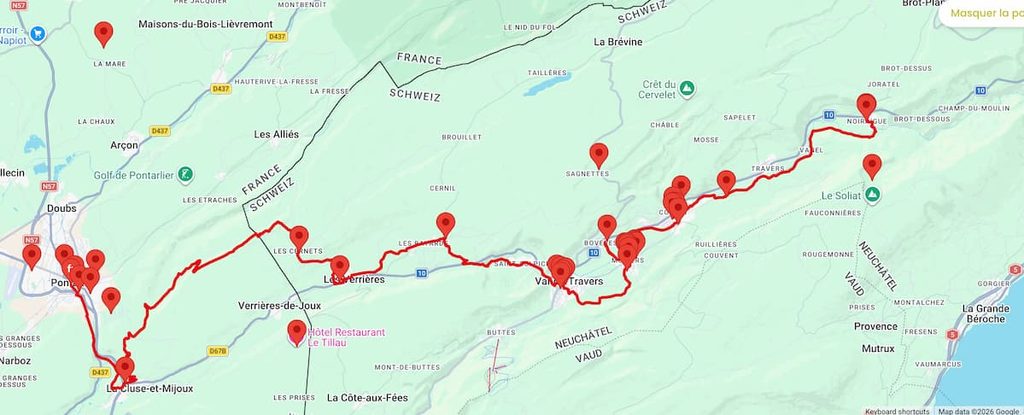
For hikers, the Absinthe Trail (Sentier de l’Absinthe) is a multi-day route spanning 48 kilometers, connecting Pontarlier in France to Noiraigue in Switzerland. It passes through distilleries, restaurants, and artisan shops.
You can also discover “Fontaines aux Fées,” or fairy fountains, which were once clandestine absinthe-tasting sites in the forests.
The best time to visit for a special experience is in June, when the annual “Absinthe en Fête” event takes place. This festival allows visitors to explore multiple distilleries and the Maison de l’Absinthe in an “open cellars” style.
Pro Tip: Take a guided tour at the Maison de l’Absinthe or a distillery to learn the intricate process and taste authentic absinthes.