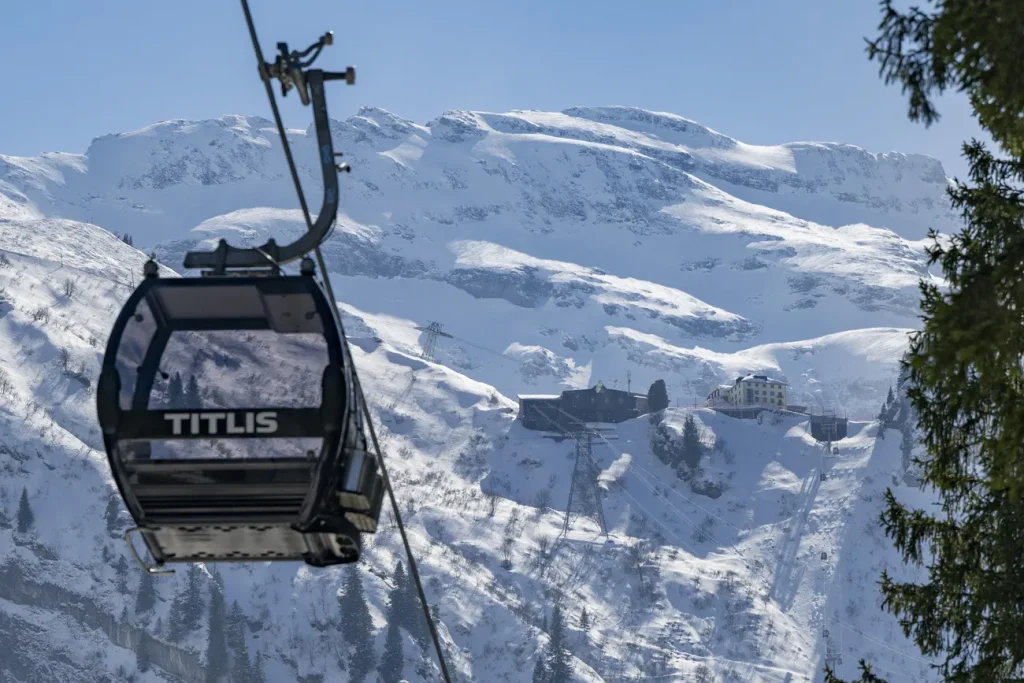
On March 18, 2026, a gondola fell from the cable in strong winds at Engelberg.
It is a tragedy precisely because it is so rare.
In a country where millions of people are transported by cable every year, an event like this makes global headlines because it goes against the near-perfect safety record of the Swiss Alps.
While the investigation into the specific mechanical failure is ongoing, the context is vital: this was an “extraordinary event” that occurred during gale force gusts exceeding 90 km/h.
It’s a sobering reminder that nature is powerful, but it doesn’t change the fact that you are statistically in one of the safest spots on earth.
So, how dangerous are gondolas really?
The Gold Standard of Swiss Engineering
Yes, I have been on hundreds of gondolas and cable cars in my life. All over Switzerland. Including insane looking ones like the one above (just last summer).
But in the back of your mind, you know that Switzerland treats its cable car network with the same obsessive precision it applies to watchmaking. The safety protocols are built on multiple layers of redundancy.
Every major lift system uses a multi-cable setup in which a single line can support the entire weight of the cabins, even if other components fail.
Swiss law requires rigorous mechanical health checks every six months. These aren’t just visual inspections. Engineers use magnetic induction testing to check the internal core of steel wires for microscopic fractures.
Automated sensors are designed to trigger secondary braking systems or slow the line to a crawl long before wind reaches dangerous thresholds.
The Daily Danger Leaderboard
So, if you are worried about dying in a Swiss gondola, let’s put the “danger” in perspective…
Driving

Want To Save This For Later?
Driving is statistically the most dangerous thing most people do. And we do it without a care in the world!
In Switzerland, the probability of an accident per mile/km traveled is significantly higher in a car than in a gondola. We just never think about it.
If you want to stay safe, don’t drive. Don’t worry about plane or gondola accidents.
You are hundreds of times more likely to be involved in a fender bender on the way to work than you are to experience a mechanical failure on the cable car.
The Staircase
It sounds absurd, but the humble staircase is a leading cause of accidental injury worldwide.
We navigate stairs in our homes with total confidence, yet the risk of falling on a flight of stairs is exponentially higher than the risk of a gondola malfunction.
You are safer suspended at 3,000 meters (10,000 ft) in a Swiss gondola than you are rushing down the stairs to catch a train.
Walking and Cycling

Being a pedestrian means dealing with lots of unpredictable human behavior and traffic.
Statistics show that moving through a city on foot or on a bike carries a much higher rate of injury per trip than sitting in a gondola.
In the mountains, the “road” is a controlled, mechanized environment with no oncoming traffic and no distracted drivers.
Final Verdict: Trust the Cable
A Swiss gondola is essentially a high tech elevator that travels horizontally. It is a closed system governed by physics and extreme regulation. While the Engelberg incident is a tragedy that the industry will learn from, the mechanical reality remains the same. You are participating in one of the safest modes of transport ever devised.