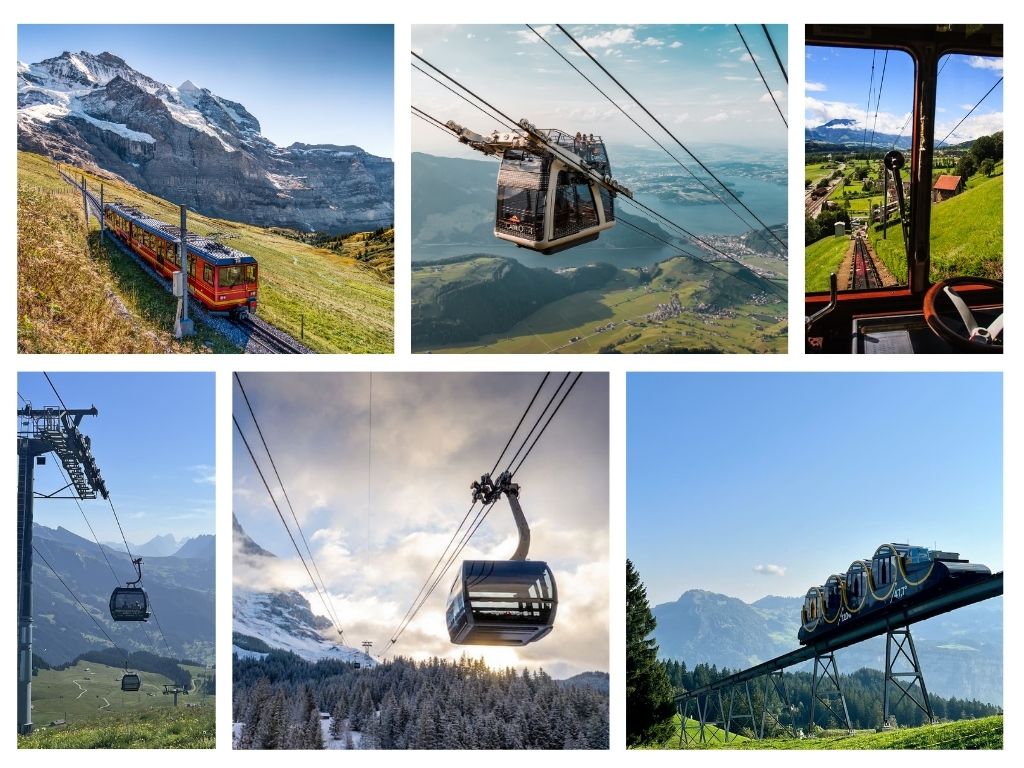
We’ve all been there: You’re standing at the base of a stunning Alpine peak or a steep coastal cliff, looking at a motorized bucket on a wire and thinking,
“Is that a cable car? A gondola? Or am I about to hop on a funicular?”
While they all share the noble goal of getting you from Point A to Point B without ruining your knees, the technology behind them is actually quite different.
Today, we’re taking a look at all methods of vertical travel so you can sound like an expert on your next trip to Switzerland.
1. The Gondola: The Continuous Loop

If you’ve ever been to a major ski resort or Disney World, you’ve likely ridden a gondola.
The main feature of a gondola is that it operates on a continuous loop. Unlike a single bus that goes back and forth, a gondola system has dozens of small cabins constantly moving. They slow down at the stations to let you hop in and out.
- Where: Grindelwald First, Männlichen from Grindelwald Terminal, bottom of Pilatus near Kriens
- Pro Tip: If it’s small and there are fifty of them, it’s a gondola.
2. The Aerial Tramway (aka Cable Car): The Big Gun
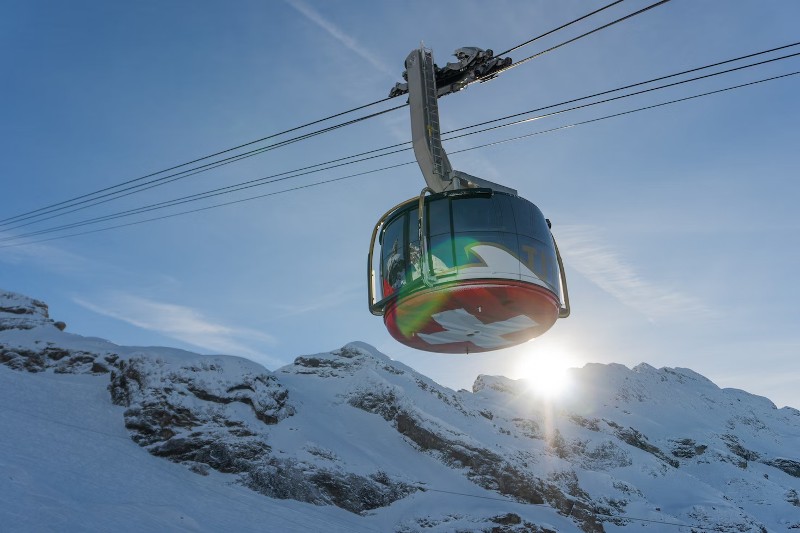
Often called a Cable Car in Europe, the Aerial Tramway is the “heavy lifter” of the sky.
Unlike the gondola’s many small cabins, a tramway usually only has two large cabins. They work on a “jig-back” system: as one cabin goes up, the other comes down, acting as a counterbalance.
These cabins can be massive, sometimes holding up to 100 people at once (think of the famous tram at Jackson Hole or the one heading up to Sugarloaf Mountain in Rio). I have often felt like a sardine during ski season when the ram you in until it almost bursts, but in summer it is usually a bit more enjoyable.
- Where: Eiger Express to Jungfraujoch, Dragon Cable Car from Pilatus, The Stanserhorn Cabrio, Titlis Rotair
- Pro Tip: If it looks like a floating bus and you have to wait for it to “arrive,” it’s a tramway.
3. The Funicular: The Mountain-Climbing Train

This is where people usually get tripped up. A funicular isn’t a “cable car” in the sense that it hangs in the air; it’s actually a railway.
A funicular consists of two cars attached to opposite ends of a cable, running on tracks up a very steep slope. Like the tramway, they counterbalance each other—the weight of the car going down helps pull the other car up.
You’ll find these in steep cities like Lisbon (ok, forget that one, as there was an accident recently), Pittsburgh (the Duquesne Incline), or Hong Kong.
Want To Save This For Later?

- Where: Funiculars can be found at Stoos, the start of Stanserhorn, Giessbach Falls has one from the water to the hotel
- Pro Tip: If it’s on tracks but feels like it’s tilted at a 45-degree angle, you’re on a funicular.
The Cogwheel Train: The “Mountain Conqueror”

While the funicular looks like a train, it’s essentially a “cable car on tracks.” If you want to talk about true, heavy-duty engineering that can climb the side of a glacier, you’re talking about the Cogwheel Train (also known as a Rack Railway).
If you’ve ever visited the Jungfraujoch in Switzerland—the “Top of Europe”—you’ve ridden the gold standard of this technology. Switzerland loves (and needs) them!

How does it work?
Standard trains rely on friction between smooth wheels and smooth rails. On a steep slope, those wheels would just spin or, worse, slide backward. A Cogwheel train solves this with a “rack and pinion” system:
- The Rack: A middle rail with “teeth” (like a long gear) laid between the two standard tracks.
- The Pinion: A motorized cog under the train that meshes with those teeth.
This mechanical grip allows the train to climb grades as steep as 48% (like the Pilatus Railway), which would be impossible for any other train.
Funicular vs. Cogwheel: What’s the difference?
This is the most common mix-up! Here is the cheat sheet:
- The Funicular is pulled by a cable. The cars are linked together; one goes up, one goes down. They can’t move independently.
- The Cogwheel Train is powered by its own engine. It doesn’t need a cable. Multiple trains can follow each other up the same track, and they can handle much longer distances (like the 9-kilometer journey through the Eiger mountain to Jungfraujoch).
At a Glance: How Do They Compare?
| Feature | Gondola | Aerial Tramway | Funicular |
| Track/Path | Cable (Aerial) | Cable (Aerial) | Rails (Ground) |
| Movement | Continuous Loop | Back and Forth | Back and Forth |
| Capacity | Small cabins, many of them | 2 Large cabins | 2 Large train cars |
| Common Use | Ski Resorts / Parks | High Mountain Peaks | Steep Cities / Cliffs |
Which One Should You Ride?
Honestly? All of them. Whether you’re soaring over a valley in a gondola or clicking up a seaside cliff in a century-old funicular, these machines are marvels of engineering. They turn a grueling hike into a scenic joyride, giving us the best views in the world without the cardio.
Next time you’re headed uphill, take a look at the cables. Now you’ll know exactly what’s pulling you!