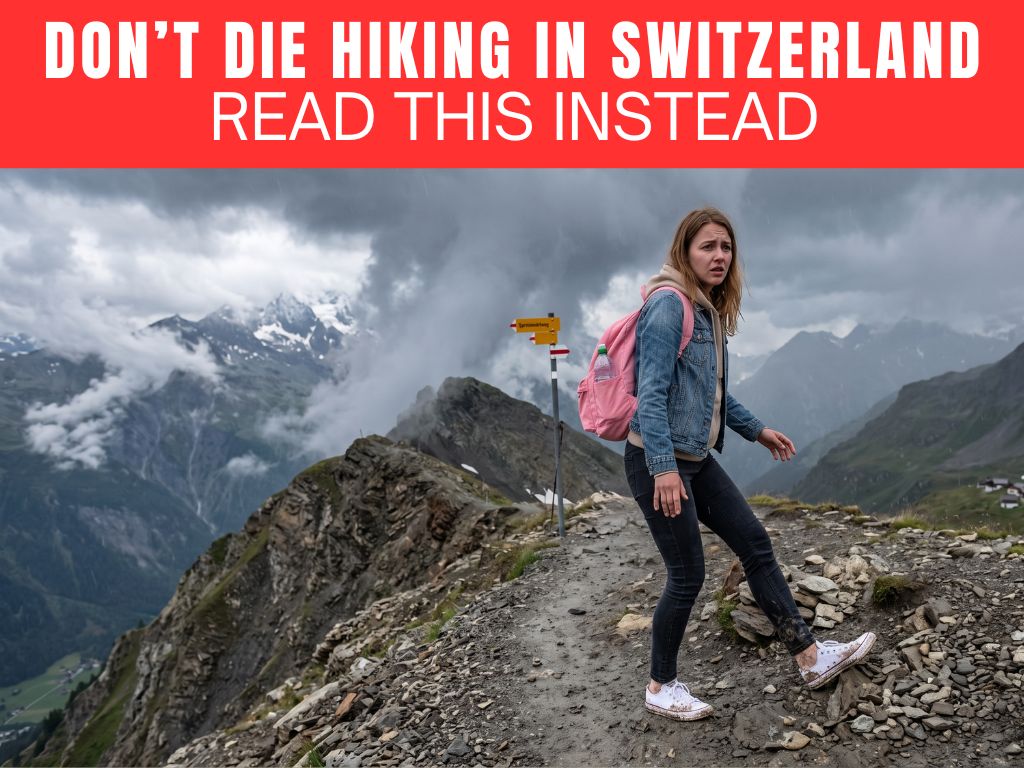
The Swiss Alps are undeniably beautiful. They look like a real-life postcard, and Switzerland’s world-class infrastructure makes reaching the clouds feel as effortless as riding an escalator.
But there’s a dark side to that convenience.
Because it’s so easy to reach the high peaks, thousands of hikers underestimate what it takes to hike up there every year.
The mountains don’t care about your fitness level, your Instagram aesthetic, or how much you paid for your flight. You could get injured, or even die, just because you bit off more than you can chew!
Tragic Reality Checks: Recent Alpine Accidents
If you think the warnings are just overblown boilerplate to scare off tourists, the recent rescue logs tell a very different story.
- The Lake Brienz / Hardergrat Fall: In July 2026, a 19-year-old American hiker tragically lost his life in the mountains overlooking Lake Brienz. He was hiking with a group, split off on his own, and during the descent near Spycheren, he lost his footing and fell off the marked trail into steep, rugged terrain. Earlier this same summer, the remains of another young hiker were found after she went missing on the notorious Hardergrat ridge path flanking the same lake. The steep drops here are breathtaking—but completely unforgiving.
There is a reason I try to discourage most people from hiking anything on the Brienzer Rothorn Ridge, unless they know what they are doing. One of the hardest and most deadly hikes on social media is heralded as “epic” all the time, yet most Swiss hikers would not even attempt the 10-hour odyssey!
- The Stoos Ridge Panic & Rescues: Further inland, the spectacular Stoos ridge hike between Klingenstock and Fronalpstock in Stoos has gone massively viral on TikTok. Because you can ride the world’s steepest funicular and a chairlift right up to the area, it attracts massive crowds of casual tourists.

- While you won’t always find a front-page news headline for every incident, Swiss Alpine Rescue and REGA (the Swiss air-rescue service) are regularly called to this exact ridge. Hikers get halfway across the narrow, chain-secured paths, realize they have severe vertigo, freeze in panic, or slip on loose gravel because they are wearing flat-soled sneakers. A trail that looks like an easy stroll on a smartphone screen can quickly turn into a psychological and physical trap.
The Illusion of Accessibility
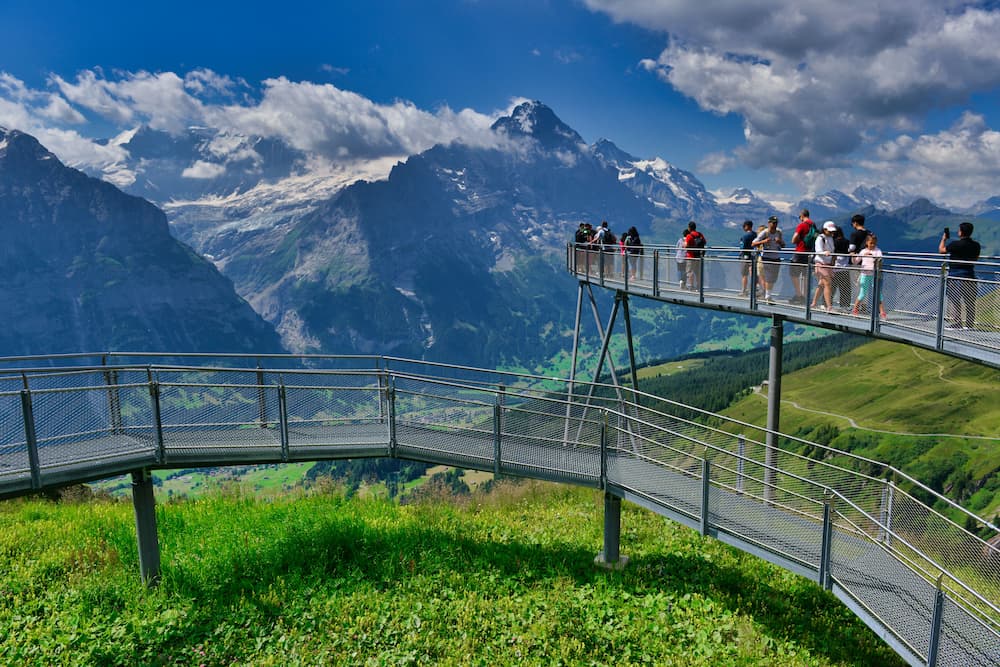
Why do smart people keep getting caught out? Ironically, it’s because Switzerland’s mountain management is too good.
When you can buy a pastry at a mountain station at 2,000+ meters, your brain tricks you into thinking you’re in a theme park. But just because a train or chairlift took you to the top doesn’t mean a paved sidewalk will take you back down.
The second you step off the viewing platform, you are in raw, high-alpine wilderness. At least in most of the cases.
Some hikes like the following are quite easy and I recommend them to my consult clients all the time:
- Männlichen Royal Walk & Männlichen Panorama Trail (1.5-2hrs)
- Mürren to Gimmelwald
- Bachalpsee from First
- Rigi Panorama Trail (Lake Lucerne)
Want To Save This For Later?
👉👉I mentioned a whole bunch more recently in this post
Critical Alpine Realities: What to Watch For
Here is an example of us hiking down on part of the Brienzer Rothorn Ridge. As you can see, it can be steep, rocky, full of stairs, and dusty. And if you don’t have sticks or a good grip, you are in for a world of pain! That is when you fall, and sometimes falling means death or serious injury.
👇👇👇 WATCH THIS
If you are planning to hit the Swiss trails, you need to know what you are actually up against. Keep these factors firmly on your radar:
- The Deceptive Descent: Hiking uphill is hard on your lungs, but hiking downhill is what gets you hurt. Gravity forces your weight forward, fatigue sets in, knees start to shake, and concentration slips. The vast majority of fatal slips happen on the way down when hikers are tired and rushing to catch the last cable car.
👉👉 GET IN SHAPE FOR SWISS WALKING (EVEN JUST SIMPLE STUFF)
- Footwear Failures: Running shoes, lifestyle sneakers, or (heaven forbid) sandals have smooth soles. On loose alpine scree (gravel) or wet rock, they act like skis. You need proper hiking boots with ankle support and aggressive Vibram-style treads to lock into the dirt.
👉👉 SEE SOME BETTER SHOE OPTIONS HERE

- Not Enough Water: One of the challenges of alpine hiking is finding water. Many of the trails you may walk on won’t have water along the way. So, come prepared with enough water (each) and expect no water – which is better than carrying none and expecting fountains along the way! (I met a lady on Stoos Ridge who was totally dehydrated for this very reason!)
- The “Group Split” Danger: If someone in your group is tired, moving slowly, or getting nervous, never let them walk alone or “head back down by themselves”. If a solo hiker slips off a ridge or loses consciousness, finding them in the vast topography of the Alps becomes a needle-in-a-haystack operation for rescue teams. Stay together.
- The Swiss Trail Rating System: Pay attention to the trail markers.
- Yellow signs: Standard walking paths (T1). Flat, wide, and safe for sneakers.
- White-Red-White signs: Mountain Hiking Trails (T2–T3). These require sure-footedness, a head for heights, and proper hiking boots with deep treads.
- White-Blue-White signs: Alpine Trails (T4–T6). These involve exposed ridges, ropes, scrambling, and absolutely zero room for error.
Respect the Altitude
Switzerland’s trails offer some of the most rewarding experiences on earth, but they demand your respect. Remember, it’s not Disney-Switzerland, it’s reality!
Nature has no safety rail, and there is no manager to complain to if the weather turns bad or the trail gets too steep.
Before you head out, check the local mountain weather apps (like MeteoSwiss), know the exact difficulty of your route, pack an extra warm and waterproof layer and a headlamp just in case, and remember: reaching the summit is optional; getting back down is mandatory.




Ashley,
Great article, thank you. I have seen people climbing in flip flops and all I can think is that I hope they make it home safe and sound.
Hope to meet you one day.
Michael
thanks Michael
Thanks so much, Ashley. I’m cautiously optimistic about the easy hikes you’re recommending. The Stoos Ridge hike does look amazing, but your warning will keep me on the Granny paths.
We just did the Klingenstock – Frohnalbstock hike and it was quite an expirience for someone like me, raised and grown up in Hamburg, where the highes altitude is 160m above sea level.
We checkt the requirements and had good hiking boots, but the hike is demanding for someone who isn’t used to do serious hiking at this altitude. Since we did several stops to do some incredible 360° drone shootings, it took us 4hr 50 minutes for the hike, that is suppost to be done in 2hr 45 minutes.
If you have vertigo or a panic being close to a drop off, just don’t do it. Same if you have problems with your knees. Taking at least 1 liter of water with you on this hike is strongly recommended.
The way from Stoos funicular station to the ski lift, that takes you up to Klingenstock, is a good test for the stuff that awaits you up there on the trail. If you have already trouble on that way and get out of breath, just ride up, take a look and ride down again, then go to the Frohnalbstock skilift and do the same. Have fun.